

How Enterprises Use Boomi DataHub for Real-Time Data Synchronization
In modern enterprises, data lives across multiple applications—ERP, CRM, eCommerce platforms, data warehouses, and industry-specific systems. When this data is inconsistent or delayed, it directly impacts operations, reporting accuracy, and customer experience. Enterprises adopt Boomi DataHub to establish a trusted, real-time data foundation that ensures critical business data remains synchronized, governed, and reliable across the ecosystem.
The Enterprise Data Synchronization Challenge
Large organizations struggle with fragmented data due to system silos, asynchronous updates, and inconsistent data standards. Customer records differ between CRM and billing systems, product data changes fail to propagate to downstream applications, and analytics teams work with outdated datasets. Batch-based synchronization introduces latency, while point-to-point integrations become complex and brittle at scale. Enterprises require a centralized, governed approach that supports real-time updates without sacrificing control.
What Boomi DataHub Brings to the Table
Boomi DataHub functions as an enterprise-grade master data management (MDM) layer. It enables organizations to define golden records for critical data domains such as customers, products, suppliers, and locations. These records are continuously synchronized with connected systems using real-time event-driven and API-based mechanisms, ensuring every application operates on the most current and accurate data.
How Enterprises Implement Real-Time Synchronization with Boomi DataHub
1. Creating a Single Source of Truth
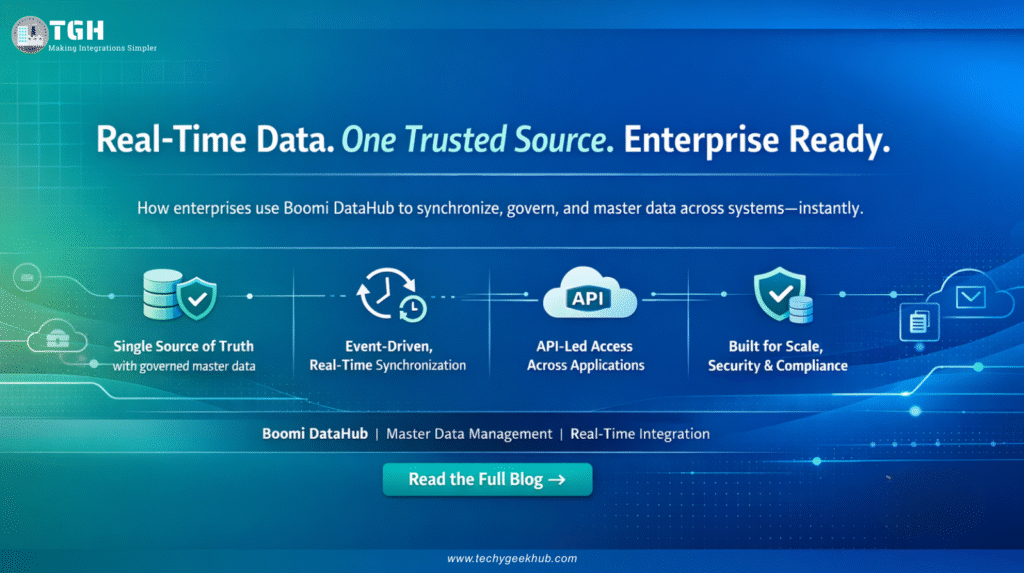
Enterprises use Boomi DataHub to consolidate data from multiple source systems into a governed golden record. Data quality rules, matching logic, and survivorship policies ensure that only validated and approved data is synchronized downstream. This eliminates duplication and conflicting records across systems.
2. Event-Driven Data Updates
Instead of relying on scheduled batch jobs, enterprises configure Boomi integrations to trigger synchronization events as soon as data changes occur. When a customer record is updated in CRM or a product price changes in ERP, Boomi DataHub immediately propagates those updates to subscribed systems, enabling near real-time consistency.
3. API-Led Synchronization Across Applications
Boomi DataHub exposes mastered data through secure APIs. Enterprises leverage these APIs to allow applications, portals, and partner systems to consume the latest data on demand. This approach supports scalable, loosely coupled architectures while maintaining centralized governance.
4. Data Governance and Compliance at Scale
Enterprises operating in regulated industries use Boomi DataHub’s governance capabilities to enforce data standards, validation rules, and approval workflows. Role-based access ensures that only authorized users or systems can modify mastered data, while audit trails provide visibility for compliance and reporting requirements.
5. Supporting Analytics and Real-Time Insights
With synchronized and trusted data flowing continuously, enterprises feed Boomi DataHub-managed data into BI platforms and data lakes in real time. This improves the accuracy of dashboards, forecasting models, and operational reporting, enabling faster and more confident decision-making.
Common Enterprise Use Cases
- Customer 360: Synchronizing customer data across CRM, ERP, marketing automation, and support systems to deliver consistent customer experiences.
- Product Information Management: Keeping product attributes, pricing, and availability synchronized across eCommerce, supply chain, and partner platforms.
- Merger and Acquisition Integration: Rapidly harmonizing data from newly acquired systems without rebuilding integrations from scratch.
- Multi-Cloud and Hybrid Environments: Ensuring consistent data flow between on-premise systems and cloud applications in complex enterprise landscapes.
Why Enterprises Choose Boomi DataHub
Enterprises adopt Boomi DataHub because it combines real-time synchronization with strong governance, scalability, and low operational overhead. Its cloud-native architecture, deep integration capabilities, and flexible deployment models allow organizations to modernize data synchronization without disrupting existing systems.
Real-time data synchronization is no longer optional for enterprises pursuing digital transformation. Boomi DataHub provides a practical, scalable way to establish trusted data, synchronize it in real time, and govern it across the enterprise. When implemented correctly, it becomes the backbone for connected systems, reliable analytics, and superior customer experiences.
Looking to implement or optimize Boomi DataHub for real-time data synchronization? TGH specializes in designing and delivering enterprise-grade Boomi DataHub and integration solutions tailored to complex business environments. Get in touch with TGH for expert consultation and integration guidance—connect with our team via the contact page to start your Boomi journey with confidence