
Why Integration Is the Backbone of Digital Transformation
Connecting Systems. Unlocking Intelligence. Scaling Enterprise Growth.
Digital transformation has become a strategic imperative for enterprises across industries. Organizations are investing heavily in cloud platforms, ERP systems, CRM applications, data analytics, automation, and AI-driven solutions to improve agility and customer experience. Yet despite these investments, many digital transformation initiatives fail to deliver sustainable business value.
The root cause is rarely the technology itself.
It is the absence of a well-defined integration strategy.
When enterprise systems operate in silos, transformation efforts remain fragmented. True digital transformation is achieved only when applications, data, and processes are seamlessly connected into a unified ecosystem. This is why enterprise integration is no longer a backend IT function—it is the backbone of digital transformation.
The Hidden Cost of a Disconnected Enterprise
Disconnected systems introduce inefficiencies that often go unnoticed until they begin to impact growth, customer satisfaction, and operational resilience. The cost of poor integration accumulates silently across the organization.
Common challenges enterprises face include:
- Business-critical data locked across multiple applications
- Manual workflows dependent on emails, spreadsheets, and re-entry
- Legacy systems slowing down innovation initiatives
- Inconsistent customer experiences across digital channels
- Shadow IT increasing security and compliance risks
These issues lead to delayed decision-making, higher operational costs, reduced visibility for leadership, and frustrated customers. Teams spend more time managing systems than driving business outcomes.
A business is only as strong as the connections between its systems.
Integration: The Enterprise Nervous System
Enterprise integration functions as the digital nervous system of an organization. It enables real-time communication between applications, data sources, and workflows—turning isolated platforms into a connected, intelligent enterprise.
Modern integration architectures focus on reusable services, governed APIs, and scalable data flows. With an integration-first approach, enterprises can:
- Enable real-time data synchronization across systems
- Support hybrid environments spanning cloud and on-premise platforms
- Reduce technical complexity and development effort
- Strengthen security, compliance, and governance
- Build a future-ready foundation for automation and AI
Integration doesn’t just connect systems—it connects how an enterprise operates, innovates, and delivers value.
How Integration Accelerates Digital Transformation
- Smarter Decisions Through Real-Time Data
Data only creates value when it flows freely across the enterprise. Integration enables unified data views, analytics-ready architectures, and accurate forecasting. Leaders gain timely insights, and teams make informed decisions instead of relying on assumptions or incomplete information.
- Seamless, Connected Customer Experiences
Customers expect consistency and personalization across every interaction. Integration ensures that customer data and context move seamlessly across channels, enabling faster onboarding, quicker issue resolution, and meaningful engagement. Connected systems lead to connected customer experiences.
- Automation Without Operational Complexity
Integration platforms and APIs eliminate manual handoffs between departments. Finance, HR, operations, and customer service workflows become automated, scalable, and reliable. Many enterprises achieve significant cost savings while improving productivity and operational efficiency.
- Legacy Modernization Without Disruption
Replacing legacy systems overnight is risky and costly. Integration allows organizations to modernize incrementally—extending existing systems with new digital capabilities while maintaining business continuity. Transformation happens at the enterprise’s pace, not at the expense of stability.
- Security and Governance by Design
Enterprise-grade integration centralizes monitoring, security, and compliance controls. APIs are secured and governed consistently, data is protected in motion, and resilience becomes an architectural standard rather than an afterthought.
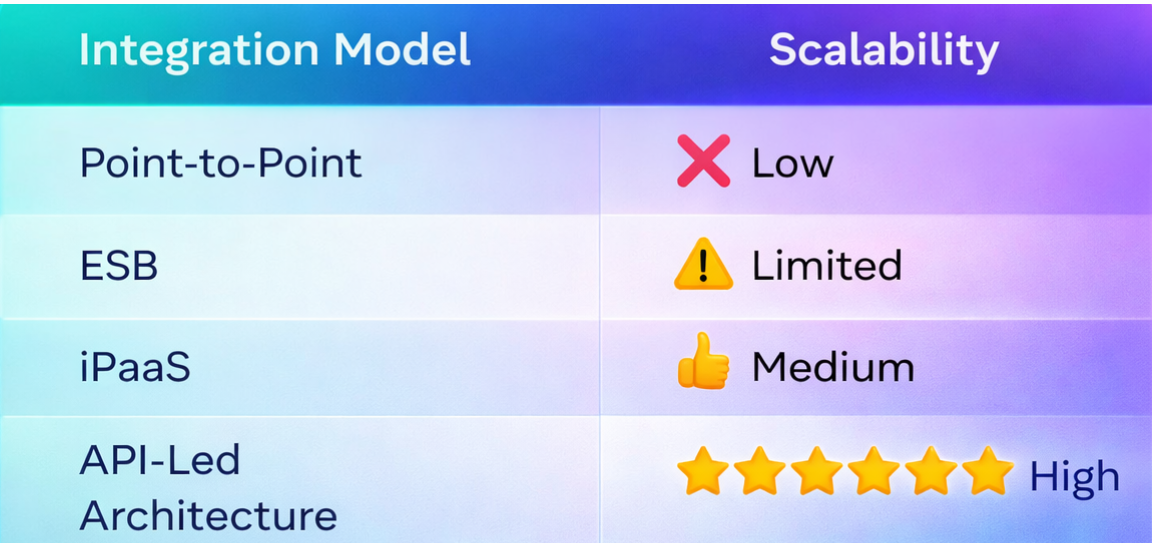
Integration Models and Scalability
Not all integration models scale equally.
As enterprises grow, point-to-point connections and traditional ESB approaches quickly become bottlenecks. Modern digital transformation requires API-led, cloud-ready integration models that support agility, governance, and continuous innovation.
TGH Perspective: Integration as a Business Enabler
At TGH Software Solutions, we approach integration as a core business capability—not just a technical task. Our focus is on designing integration architectures that align technology with enterprise goals, enabling measurable business outcomes.
We help organizations:
- Eliminate system silos
- Accelerate automation initiatives
- Modernize legacy environments safely
- Build scalable, AI-ready integration architectures
- Maintain governance and security at enterprise scale
Our expertise spans enterprise platforms, APIs, cloud ecosystems, and hybrid environments—enabling transformation without disruption.
TGH Range of Integration Services
TGH delivers end-to-end enterprise integration services, covering strategy, design, implementation, and optimization.
Integration Strategy & Architecture Consulting
We assess your existing integration landscape, identify gaps, and define a future-ready integration roadmap aligned with business priorities.
iPaaS & API-Led Integration Services
TGH is a trusted integration partner with deep expertise across leading platforms:
- Boomi for API-led connectivity and hybrid integration
- Workato for intelligent automation and workflow orchestration
- Celigo for scalable SaaS integrations and ecosystem automation
Our partner-led approach ensures best practices, faster delivery, and platform-optimized solutions.
Application, Data & Workflow Integration
We connect ERP, CRM, finance, HR, eCommerce, and custom applications, enabling real-time data flow and automated business processes.
Legacy Modernization & Hybrid Integration
We modernize legacy systems through APIs and integration layers—preserving stability while enabling innovation.
Integration Governance, Security & Optimization
We implement centralized monitoring, security policies, and performance optimization to ensure integrations remain resilient and scalable over time.
AI-Ready Integration: The Road Ahead
The future of digital enterprises is driven by AI, automation, and advanced analytics. These capabilities depend on clean, connected, and well-governed data foundations.
AI initiatives succeed only when integration is done right.
Enterprises that invest in strong integration architectures today will be positioned to adopt intelligent automation, predictive analytics, and next-generation digital capabilities tomorrow.
Ready to Build a Connected Enterprise?
Digital transformation succeeds only when systems work together.
Integration is not just infrastructure—it is the foundation of agility, innovation, and exceptional customer experience.
Let TGH Software Solutions help you turn integration into a strategic advantage.
Talk to our integration experts to assess your integration maturity, identify gaps, and design a future-ready enterprise architecture.
👉 Contact TGH today for a free enterprise integration consultation and start building a connected, scalable, AI-ready enterprise.