Core Capabilities Every Enterprise Automation & Integration Platform Must Deliver in 2026
Enterprise automation and integration platforms connect applications, automate workflows, synchronize data, and manage APIs across cloud, on-premise, and hybrid environments. In 2026, enterprises prioritize platforms offering scalability, AI-driven automation, real-time integration, governance, and low-code capabilities.
What Is an Enterprise Automation & Integration Platform?
A platform that enables businesses to connect systems, automate processes, manage APIs, and streamline data exchange across environments.
Key uses:
- Integrate SaaS and on-premise systems
- Automate workflows and synchronize data
- Enable API-led connectivity
- Reduce manual intervention
Leading platforms — Boomi, MuleSoft, and Workato — are helping enterprises modernize through scalable, intelligent automation.
Why It Matters in 2026
Modern enterprises manage multi-cloud infrastructure, hybrid ecosystems, real-time customer demands, distributed workforces, and increasing compliance requirements. Traditional point-to-point integrations can no longer keep up. Businesses now need centralized platforms to orchestrate workflows across hundreds of applications with governance and security built in.
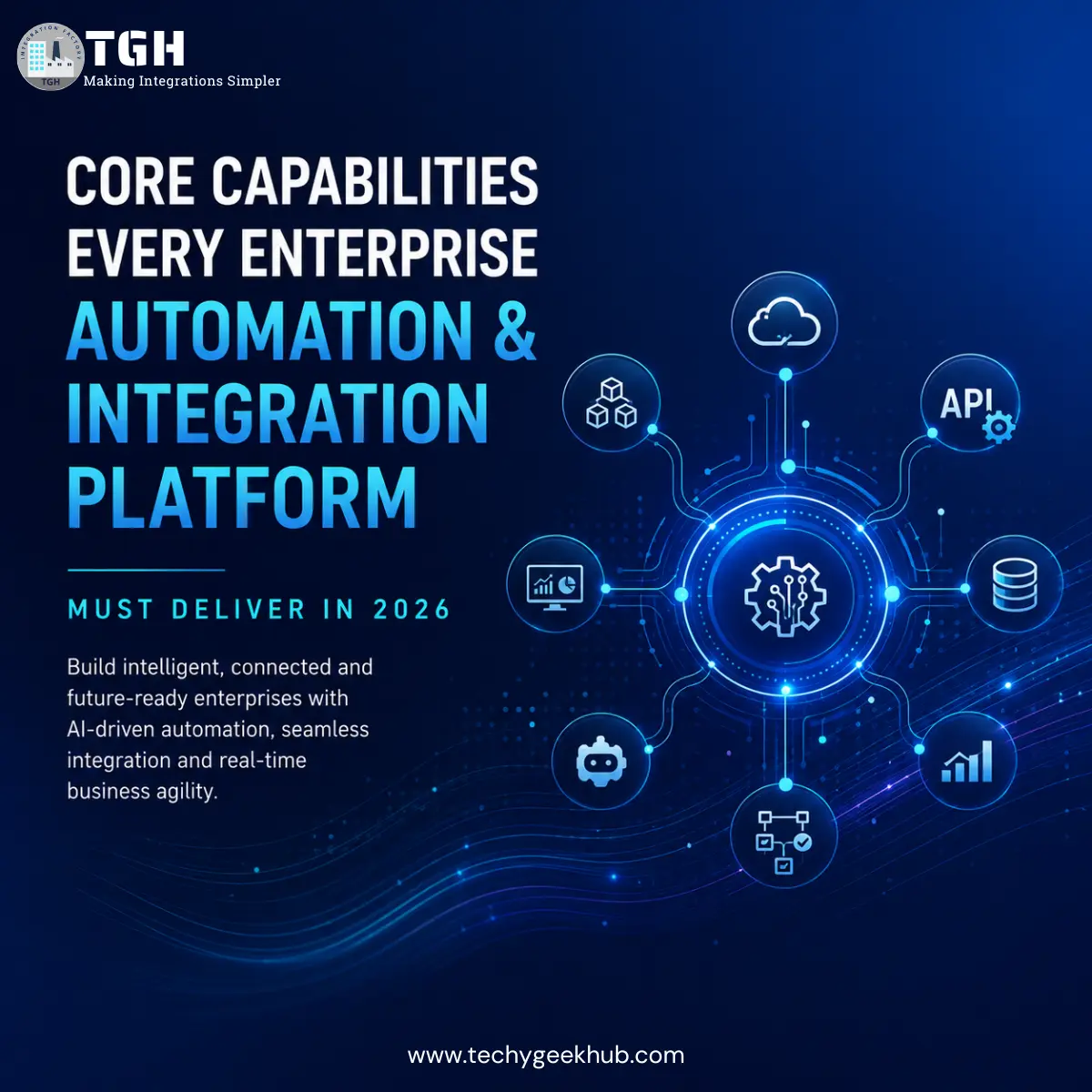
10 Core Capabilities
1. Application Integration Connects cloud, on-premise, hybrid, and legacy systems through prebuilt connectors — eliminating data silos across Salesforce, SAP, Workday, Jira, and more.
2. Workflow Automation Automates repetitive processes like employee onboarding, invoice approvals, ticket routing, and order processing — reducing errors and accelerating decisions.
3. API Management Securely expose, monitor, and govern APIs with gateway management, lifecycle control, developer portals, traffic monitoring, and rate limiting.
4. Real-Time Data Synchronization Processes events instantly, triggers automated workflows, and keeps systems continuously in sync — critical for inventory, fraud detection, and financial reporting.
5. Low-Code / No-Code Development Drag-and-drop builders and reusable templates enable business teams to build automations without full developer dependency — driving Workato’s rapid adoption.
6. AI-Driven Automation Supports predictive routing, intelligent document processing, anomaly detection, AI copilots, and natural language workflow generation.
7. Data Governance & Security Role-based access, encryption, audit logging, compliance monitoring, and data masking — essential for healthcare, banking, and manufacturing.
8. Scalability & Performance Handles high-volume transactions, global deployments, elastic scaling, and event-driven processing without compromising uptime.
9. Monitoring & Observability Centralized dashboards track workflow performance, API health, error handling, and automation metrics — enabling proactive issue resolution.
10. Hybrid & Multi-Cloud Support Native support for AWS, Azure, Google Cloud, hybrid environments, and legacy infrastructure.
Business Challenges Solved
| Challenge | Solution |
| Data silos | Unified connectivity |
| Manual approvals | Automated workflows |
| Slow operations | Real-time orchestration |
| Duplicate data | Centralized synchronization |
| High costs | Process automation |
| Compliance risks | Governance controls |
Key Selection Criteria
When choosing an iPaaS platform, evaluate: scalability, security, connector ecosystem, API management, AI capabilities, low-code support, governance, and vendor maturity. Always align with long-term transformation goals — not just immediate needs.
2026 Trends to Watch
- AI-Native Automation — Intelligent workflow orchestration
- Event-Driven Architecture — Real-time enterprise responsiveness
- API-First Strategy — Reusable, scalable connectivity
- Hyperautomation — AI + automation + analytics combined
- Unified Data Ecosystems — Single visibility across all systems
Final Thoughts
Enterprise automation platforms are now foundational to digital business. Organizations investing in integration, automation, API management, and AI orchestration gain a clear advantage in efficiency, innovation, and customer experience. Whether choosing Boomi, MuleSoft, or Workato — build for the future, not just today.
Frequently Asked Questions
A platform connecting applications, automating workflows, managing APIs, and synchronizing data across cloud and on-premise systems.
It reduces manual tasks, minimizes errors, and accelerates business processes.
A cloud-based platform to connect applications, automate integrations, and manage enterprise workflows.
Improved scalability, security, governance, and enterprise connectivity.
Through intelligent routing, predictive analytics, anomaly detection, and natural language orchestration.
Healthcare, manufacturing, retail, financial services, logistics, and technology.
Build an Enterprise Automation Strategy Designed for Scale
As organizations move toward AI-enabled operations, real-time data ecosystems, and automation-first business models, enterprise integration platforms are becoming foundational to operational agility and long-term transformation success.
At TGH Software Solutions, we help enterprises design scalable integration architectures, modernize legacy connectivity environments, and implement intelligent automation strategies using platforms like Boomi, MuleSoft, and Workato.
Whether your organization is evaluating iPaaS solutions, scaling API ecosystems, enabling workflow automation, or modernizing hybrid enterprise environments, TGH delivers the technical expertise and strategic guidance required for enterprise-scale transformation.
Explore how TGH can help your business build a connected, automation-ready digital ecosystem designed for the future.
