


Hybrid EDI API Integration: Why Businesses Are Combining EDI and APIs Instead of Replacing Them
For years, the enterprise integration space has debated EDI vs API.
One side viewed EDI (Electronic Data Interchange) as the trusted standard for exchanging business documents, while the other saw APIs as the future of real-time connectivity and modern applications.
Today, that conversation changed.
As organizations continue their digital transformation journey, the focus is no longer on EDI versus API. Instead, businesses are asking a different question:
How can EDI and APIs work together?
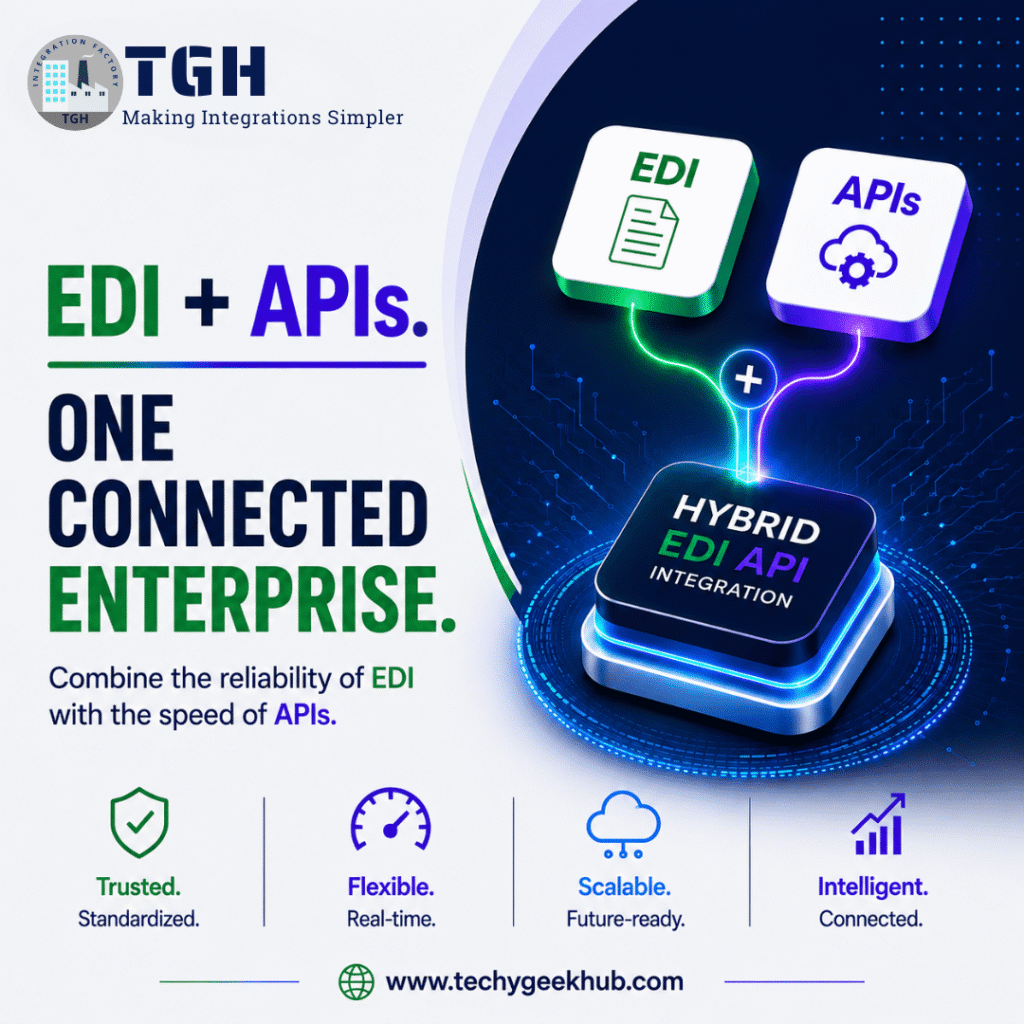
The answer is hybrid EDI API integration, a modern approach that combines the reliability of EDI with the speed and flexibility of APIs using a single enterprise integration platform.
EDI Is Not Going Away, It’s Evolving
EDI, or Electronic Data Interchange, has been the backbone of business data exchange for decades. Every day, millions of purchase orders, invoices, advance ship notices (ASN), and shipping documents are exchanged using standardized EDI formats such as ANSI X12 and EDIFACT.
Manufacturers, retailers, healthcare providers, and logistics companies continue to rely on an EDI integration platform because it offers:
- Reliable information exchange
- Standardized messaging
- Secure information exchange
- High transaction volumes
- Compliance with trading partner requirements
Despite the rapid adoption of cloud applications and APIs, EDI remains one of the most dependable technologies for standardized B2B document exchange.
The Real Challenge Isn’t EDI
The real challenge isn’t EDI itself.
The problem is that many organizations still use EDI as a standalone system without connecting it to the rest of their business applications in real time.
As a result, information often becomes trapped in silos, making it difficult for ERP systems, warehouse applications, CRM platforms, and cloud applications to respond instantly.
Modern organizations need EDI to become part of a broader enterprise integration platform, where EDI and APIs work together to provide complete visibility across business operations.
This is exactly why hybrid EDI API integration is gaining momentum.
Instead of replacing EDI, organizations are combining EDI with modern API management tools to build an interconnected ecosystem of applications, trading partners, and business systems while continuing to comply with industry standards.
What Is Hybrid EDI API Integration?
Hybrid EDI API integration combines the strengths of both technologies by enabling EDI and APIs to work together on a single integration architecture.
Instead of maintaining separate EDI translators and API middleware, businesses use one unified enterprise integration platform, such as Boomi or MuleSoft, to manage:
- Standard ANSI X12 transactions
- EDIFACT transactions
- API integrations
- Real-time application connectivity
This approach simplifies integration while improving operational efficiency.
Some of the most common use cases include:
- Real-time order processing
- Improved ERP integration
- Faster trading partner onboarding
- Reduced operational costs
- Greater scalability and flexibility
Real-Time Order Processing with EDI and APIs
Imagine a customer sending a purchase order through EDI.
Instead of waiting for batch processing, APIs immediately:
- Create the sales order
- Update inventory
- Notify warehouse systems
- Trigger fulfillment workflows
Here, EDI continues handling standardized business documents while APIs enable real-time communication across enterprise applications.
The result is faster order processing and improved customer experience.
Improved ERP Integration
Modern ERP systems increasingly support direct connectivity through APIs.
Using hybrid EDI API integration, organizations can ensure that EDI transactions are processed while APIs synchronize information instantly with ERP platforms such as:
- SAP S/4HANA
- Oracle
- NetSuite
- Microsoft Dynamics 365
This gives operations teams real-time visibility into inventory, shipments, procurement, and order status instead of relying solely on scheduled EDI updates.
Faster Trading Partner Onboarding
Traditional EDI onboarding can be time-consuming.
It often requires complex mapping, testing, and document validation.
With hybrid EDI API integration, new trading partners can exchange data through APIs while the integration platform automatically converts information into the required EDI format behind the scenes.
This reduces onboarding complexity while maintaining full compliance with existing trading partner standards.
Reduced Costs
Running separate EDI translators, middleware, and API platforms often increases maintenance costs.
A unified EDI integration platform helps organizations:
- Reduce infrastructure costs
- Eliminate integration silos
- Simplify management
- Lower maintenance overhead
This makes enterprise integration more cost-effective over time.
Greater Flexibility and Scalability
Organizations don’t need to replace their existing EDI investments.
Instead, they can extend legacy EDI systems by connecting them with APIs, cloud applications, and microservices.
This hybrid architecture provides the flexibility to modernize gradually while supporting future business growth.
Rather than locking the business into a single technology, organizations gain an integration strategy that evolves with changing business requirements.
Planning Your EDI Modernization Strategy
Not every organization should choose an API-only or EDI-only approach.
For many businesses, hybrid EDI API integration offers the best balance between reliability, flexibility, and cost.
When planning your modernization strategy, consider:
- Choosing the right enterprise integration platform (Boomi, MuleSoft, Workato, Celigo, etc.)
- Deciding which APIs should be built or reused
- Selecting the appropriate EDI standards
- Planning governance, implementation, and monitoring
- Designing a scalable integration architecture
Every organization’s integration landscape is different, so the right approach depends on business goals, existing systems, and future growth plans.
Final Thoughts
The discussion is no longer EDI vs API.
It’s about combining both technologies to create smarter, faster, and more connected business processes.A modern hybrid EDI API integration strategy enables organizations to retain the reliability of EDI while benefiting from real-time APIs, automation, and cloud connectivity.
Instead of replacing existing investments, businesses can modernize incrementally using the right EDI integration platform and enterprise integration platform to build a future-ready integration architecture.
Ready to Modernize Your EDI Strategy?
Whether you’re planning an EDI modernization project, migrating to a new enterprise integration platform, or looking to implement hybrid EDI API integration, TGH Software Solutions can help.
Our experts specialize in designing scalable integration solutions using Boomi, MuleSoft, Workato, and Celigo, helping businesses connect applications, automate B2B processes, and future-proof integration landscapes.
Talk to our integration experts today and discover how the right hybrid EDI API integration strategy can accelerate your digital transformation.
